
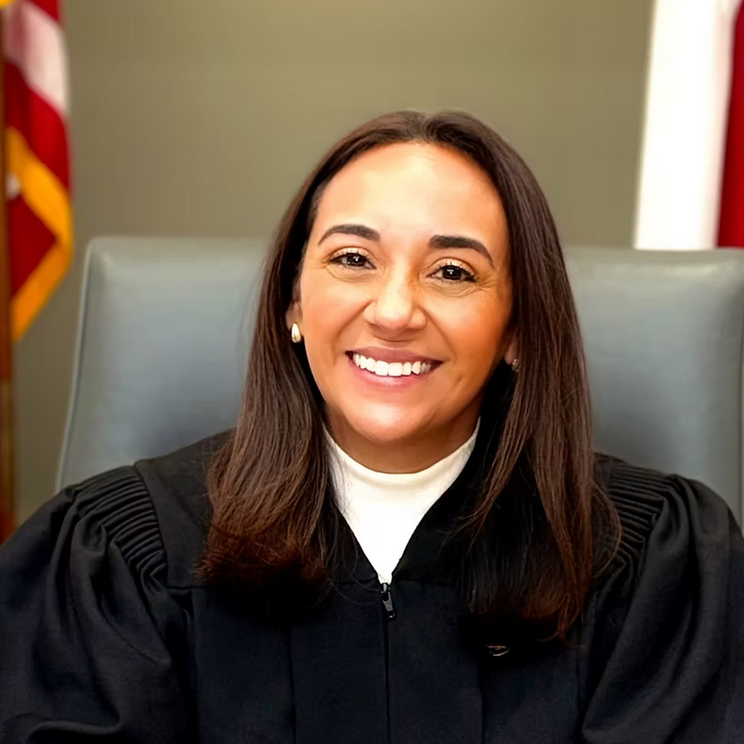
Maggie Hernandez Moreno
Candidate for Justice of the Peace 1-2 (Incumbent)*
Endorsed by Hays Young Democrats
Maggie Hernandez Moreno was born and raised in San Marcos and has spent her life committed to serving the community she calls home. She has proudly served as a Judge for nearly a decade (beginning in October 2016), bringing fairness, integrity, and real world experience to the bench. During her time on the court, she has presided over criminal and civil matters, jury trials, truancy cases, and a wide range of cases that affect families and neighborhoods every day.
-
II am seeking the endorsement of the HCYD because I feel that my political views, track record as an elected official and community involvement align with the work of the HCYD.
-
have spent almost a decade on the bench as the Justice of the Peace 1-2 and have completed over 200 hours of judicial training through the Texas Justice Court Training Center. I have the presided over criminal, civil, truancy, evictions cases and completed over 500 death investigations in my role as a Justice of the Peace. I have been active in non-profit and civic organizations here in San Marcos where I worked side by side with my neighbors to help solve issues in the community such as food and housing insecurities. The work I do in the community allows me to bring that same problem solving mind set to the bench. Often times, the problems we try to solve in these organization relate directly to issues faced by those in the courts.
-
My first goal would be to continue to ensure my office has policies and procedures in place that help prevent barriers to the court. For example, we currently offer Zoom appearances for those who are unable to miss work and phone conference pre-trials for people who cannot afford to spend time in court waiting for their chance to speak to a prosecutor. I will continue to use technology as it becomes available to ensure the court is accessible to everyone. My second goal would be to advocate for the expansion of representation at eviction appeals in the county courts at law. At present time the public defenders office is not 100% funded and therefore expanding it help those facing eviction would require the county to find the funds to cover all these expenses. My last goal would be to improve the website for the JP1-2 office. Hays County invested in updating the website for the county a few years back but the JP website is not very useful for those trying to navigate the court system when compared to the Travis County JP website that offers step by step videos and is much more user friendly. We try to ensure that all relevant forms are available on our website but it can difficult for pro se litigants to know how to complete the correct paperwork. Hays County has a Law Library with lots of helpful resources that we often refer people to.
-
I would choose "Brave" by Sara Bareilles. I first heard this song back in 2013 when I was working for the Comal County Health Department and my co-worker introduced me to her music. I feel that this song speaks to my belief that we should be the voices for those who are not brave enough to speak for themselves. This song also speaks to me in the current political climate where we are demanding that those elected to represent us on the state and national level must be "brave" and speak about the injustices occurring across the US. There are lyrics that talk about darkness and over coming that to let your light shine. I relate this to the importance of mental health and the belief that these services should be available to everyone regardless of finances. In the death investigation part of my job I have seen too often the consequences when people cannot afford to seek mental health care or afford their medications. In my role as a community leader I try to empower others to be brave.
-
The role of a judge is to follow the rule of law, depending on what kind of judge they are. On a federal level is it imperative that a judge follow the constitution and make rulings that align with the law. On my level, this means ensuring that everyone is on a level playing field. In my court often people often represent themselves and my role is to ensure that the law is applied fairly and justly to everyone.
-
In my court this means that the law is applied the same for everyone not just individuals who have the financial means to afford an attorney. The justice courts are often referred to as "the people's court" because the majority of people in our courts are pro se. I believe that in my decade on the bench I have ensured that this is the way I administer justice in my court.
-
In my court I often see people who cannot afford to pay their fines and court costs, we offer everyone a form called "Statement of Inability to Pay" to ensure that they are offered the opportunity to complete community service in place of paying any costs. This same form allows people to file suits even if they cannot afford to pay the filing fee. In our court someone's lack of financial resources does not have any adverse results when compared to someone who has access to financial resources.
Judges can interrupt this by insisting on individualized, fact-specific decisions—by conducting meaningful ability-to-pay inquiries and by refusing to incarcerate for nonpayment caused by genuine inability rather than willful refusal. Orders must be realistic and tied to lawful objectives, not revenue.
Structural choices matter. Private companies that collect court fines and impose an automatic 30% surcharge create perverse incentives and deepen hardship. Ending private collections and returning the process to public control removes profit from punishment.
Bail decisions are equally critical. No one should remain jailed simply because they cannot afford bail. Judges must make individualized, risk-based decisions grounded in statute, not wealth. Pretrial detention should be the exception, not the default.
Finally, expanding diversion, coordinating with pretrial services, and managing dockets to minimize unnecessary delays helps ensure justice is fair, proportional, and not dependent on money.