
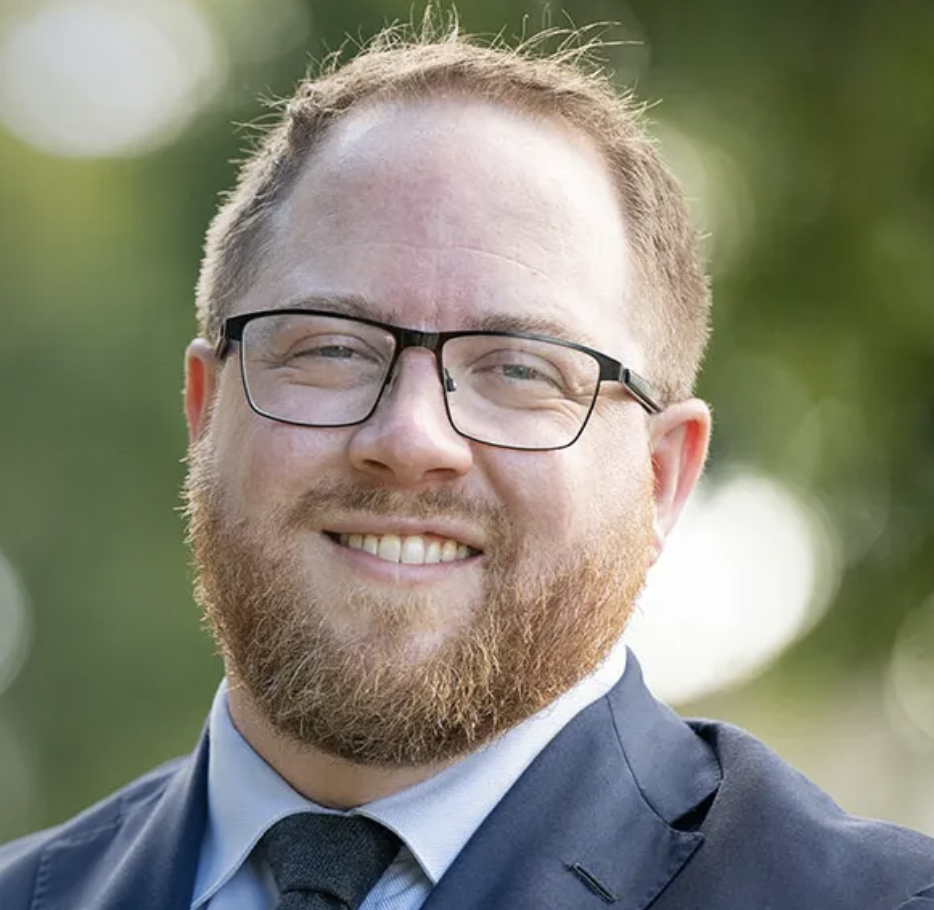
Thomas Just
Candidate for Hays County Court at Law #2*
Endorsed by Hays Young Democrats
Thomas Just is a veteran, a courtroom advocate, and a leader with deep roots in Hays County. He’s not just running for judge—he’s running to fix a broken system and bring fairness to everyone who walks into a courtroom.
-
I’m seeking the Hays County Young Democrats’ endorsement because your members are the next generation of Democratic leadership, and this race is about values, clarity, and trust in our courts. My campaign is distinct: I’ve litigated the full range of matters before this court—criminal, civil, probate/guardianship, juvenile, and mental-health proceedings. I’m running a reform agenda centered on access, dignity, and accountability: a young-adult diversion court; a juvenile mental-health diversion track; reliable in-person Spanish interpretation; full funding for the Public Defender’s Office; ending the 30% private-collections surcharge; and greater transparency through public court data. I’m asking for your endorsement so we can build a justice system that earns public trust and serves everyone—not just the well-connected.
-
My public service began in the U.S. Air Force, where I served as a senior intelligence analyst and developed skills in evidence evaluation, bias awareness, and accountability that directly inform judicial decision-making. I used my GI Bill to attend the University of Texas at Austin and Seattle University School of Law.
I built my legal career in the courtroom, handling contested matters across the full docket of this court: Class A and B misdemeanors, civil disputes, probate and guardianship proceedings, juvenile and mental-health cases, and de novo appeals. I have also handled serious felony matters and practiced in federal court. Outside the courtroom, I led public-integrity litigation in Hays County, including successfully removing an incompetent district clerk and exposing the unauthorized practice of law, which resulted in a felony conviction.
In addition to my legal work, I have served as Vice Chair of the Hays County Democratic Party and on the board of the Kyle-Buda Area Democrats, helping strengthen local party infrastructure and civic engagement. My leadership is grounded in service, transparency, and the belief that public office is a solemn responsibility—not a privilege.
-
1. Build a fairer, more accessible court. I will advocate for a fully funded Public Defender’s Office and ensure reliable, qualified in-person Spanish interpretation so meaningful participation in court does not depend on wealth or English fluency.
2. Deliver evidence-based, problem-solving justice. I will establish a young-adult (18–24) diversion court, create a juvenile mental health diversion track, and modernize Veterans Treatment Court by implementing evidence-based practices that improve public safety and reduce repeat involvement.
3. End wealth-based harm and increase transparency. Courts should not profit from the people they serve. I will advocate ending private fine-collection contracts that impose a 30% surcharge and support publishing clear, public court metrics on backlogs, clearance rates, and outcomes to strengthen accountability and trust.
-
“Bohemian Rhapsody” by Queen. It reflects resilience, complexity, and confidence in navigating difficult moments—qualities that matter when making decisions that affect real people’s lives.
-
A judge’s role today is to safeguard and uphold the rule of law—the cornerstone of our democracy—especially when it is under attack. This role is not merely technical. A judge is not simply a legal mechanic applying rules in isolation, but a public servant entrusted with the solemn duty to defend the constitutional framework that allows a free society to function. Judicial independence, fidelity to the Constitution, and consistent application of the law are essential, particularly when cases are unpopular or public opinion runs contrary to constitutional protections.
I went to law school in no small part because I have seen what happens when the rule of law collapses. Through my service connected to Iraq and Afghanistan, I witnessed how societies unravel when courts lose legitimacy, power replaces law, and rights exist only at the discretion of those in control. Democracies fail not all at once, but through erosion, shortcuts, and the quiet abandonment of legal restraint.
Safeguarding the rule of law also requires addressing structural failures that undermine legitimacy: overwhelmed courts, inconsistent language access, under-resourced defense systems, wealth-based penalties, and opaque processes that breed mistrust. Within ethical limits, a judge must lead by ensuring the court is predictable, transparent, and accessible, insisting on fair procedures, reliable evidence, and clear rulings.
Because many of these challenges involve resources and administration, I will work—within ethical boundaries—with the Hays County Commissioners Court and justice-system partners to advocate for adequate staffing, interpreter capacity, pretrial services, and public-defense funding, while maintaining judicial independence and impartiality.
-
Equal justice under the law means the same rules, the same process, and the same respect for everyone—regardless of wealth, race, language, political influence, or social connections. In daily practice, it requires disciplined adherence to the Constitution, the rules of evidence and procedure, and binding precedent, so that decisions are grounded in law and facts, not expediency or status.
Equal justice begins with meaningful access: qualified interpreters, clear notice, plain-language explanations, and protection of the right to counsel. No one should be rushed through a system they cannot realistically navigate simply because a docket is crowded or a case is labeled “routine.”
It also requires consistency and transparency. Like cases should be treated alike, and departures explained on the record. Orders must be clear, enforceable, and tailored to the individual—not generic templates.
Critically, equal justice requires independence from informal power structures. A judge committed to equal justice cannot be part of a “good-ol’-boy” system that preserves the status quo for the connected. Justice fails when outcomes depend more on relationships than on law and evidence. Equal justice requires the courage to apply the law equally to everyone, especially when doing so is uncomfortable.
-
Courts punish poverty when fines, fees, bail, and conditions are imposed without regard to a person’s actual ability to pay or comply. Many misdemeanor offenses tied to poverty, housing instability, addiction, and untreated mental illness function less as public-safety measures and more as cycles of harm.
Judges can interrupt this by insisting on individualized, fact-specific decisions—by conducting meaningful ability-to-pay inquiries and by refusing to incarcerate for nonpayment caused by genuine inability rather than willful refusal. Orders must be realistic and tied to lawful objectives, not revenue.
Structural choices matter. Private companies that collect court fines and impose an automatic 30% surcharge create perverse incentives and deepen hardship. Ending private collections and returning the process to public control removes profit from punishment.
Bail decisions are equally critical. No one should remain jailed simply because they cannot afford bail. Judges must make individualized, risk-based decisions grounded in statute, not wealth. Pretrial detention should be the exception, not the default.
Finally, expanding diversion, coordinating with pretrial services, and managing dockets to minimize unnecessary delays helps ensure justice is fair, proportional, and not dependent on money.